When choosing a primary care physician, many patients wonder about the distinction between family and internal medicine practitioners. Both specialties form the foundation of primary care in the United States, yet they differ in training, patient populations, and clinical approaches. Understanding these differences helps patients make informed decisions about their healthcare and ensures they receive the most appropriate care for their specific needs. Both family physicians and internists serve as first-contact providers who diagnose, treat, and manage a wide range of health conditions while coordinating care with specialists when necessary.
Understanding the Core Differences Between These Medical Specialties
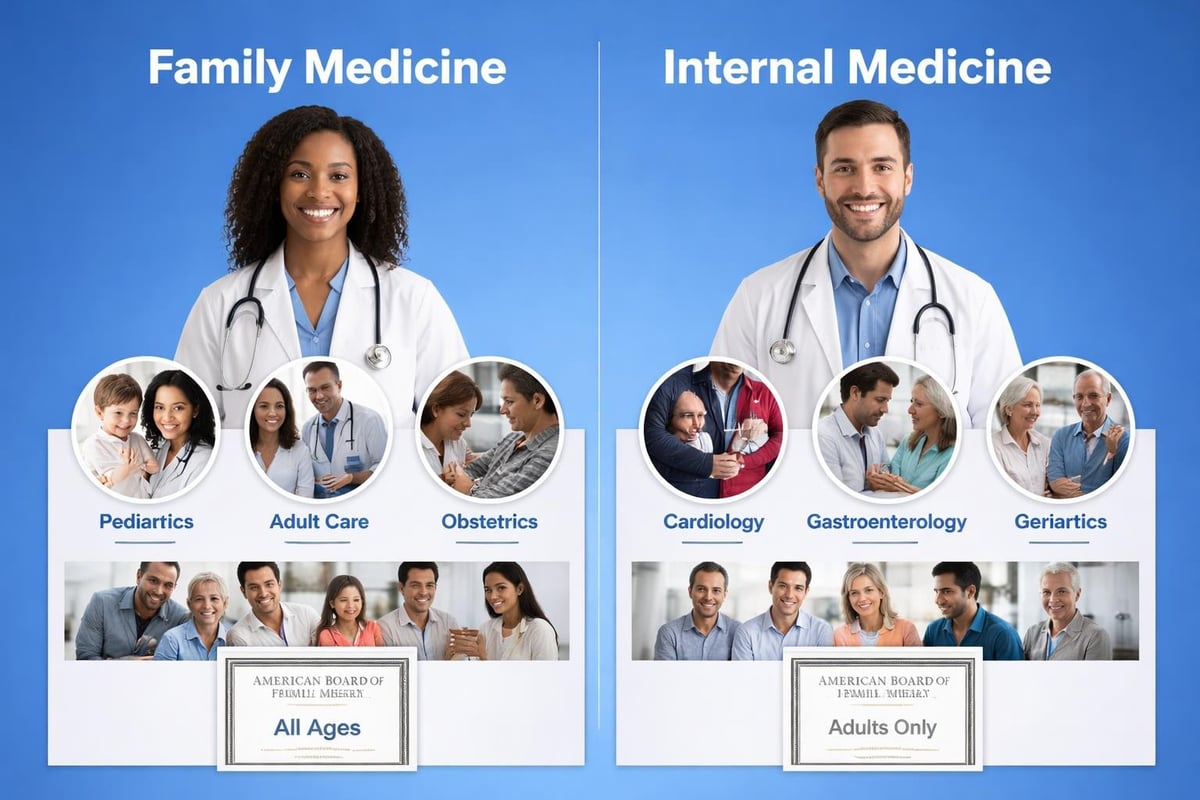
Family medicine and internal medicine share the common goal of providing comprehensive primary care, but their scope and focus diverge in meaningful ways. Family physicians train to care for patients across the entire lifespan, from newborns to elderly adults, making them true generalists in the medical field. Their training encompasses pediatrics, obstetrics, gynecology, orthopedics, and geriatrics, enabling them to serve as the sole physician for entire families.
Internal medicine physicians, commonly called internists, specialize exclusively in adult medicine. Their training focuses deeply on the prevention, diagnosis, and treatment of diseases affecting adults, with particular expertise in managing complex, chronic conditions and multiple comorbidities. The American College of Physicians provides detailed insights into how these specialties developed different patient populations and training approaches.
Training and Certification Requirements
Both specialties require completion of medical school followed by a residency program, but the content and emphasis differ significantly:
Family Medicine Training:
- Three-year residency program
- Rotations in pediatrics, obstetrics, surgery, and emergency medicine
- Outpatient clinic experience across all age groups
- Board certification through the American Board of Family Medicine
Internal Medicine Training:
- Three-year residency program focused on adult patients
- Intensive hospital-based training in complex disease management
- Subspecialty fellowship options (cardiology, gastroenterology, etc.)
- Board certification through the American Board of Internal Medicine
Patient Populations and Scope of Practice
The patient populations served by family and internal medicine physicians represent one of the most significant distinctions between these specialties. Family physicians embrace a cradle-to-grave philosophy, providing continuity of care that spans generations. This approach allows them to understand family health patterns, genetic predispositions, and social determinants of health that affect multiple family members.
Research shows that the breadth of a family physician's practice significantly impacts their clinical performance. Studies examining the scope of practice demonstrate that maintaining a comprehensive practice correlates with better outcomes on board certification examinations.
Age-Specific Care Considerations
| Specialty | Age Range | Common Conditions Treated | Preventive Care Focus |
|---|---|---|---|
| Family Medicine | All ages (birth to elderly) | Well-child visits, sports physicals, prenatal care, chronic disease management | Immunizations, developmental screenings, cancer screenings, geriatric assessments |
| Internal Medicine | Adults (18+ years) | Hypertension, diabetes, heart disease, autoimmune disorders | Adult vaccinations, cardiovascular screening, metabolic health, age-specific cancer screening |
Internal medicine physicians typically see patients starting in late adolescence or early adulthood. Their expertise shines when managing patients with multiple chronic conditions requiring careful medication management and specialist coordination. Many internists develop particular expertise in hospital medicine, serving as hospitalists who manage acutely ill patients during inpatient stays.
Clinical Approach and Philosophy of Care
The clinical philosophy underlying family and internal medicine shapes how physicians in each specialty approach patient care. Family medicine embraces a biopsychosocial model that considers biological, psychological, and social factors influencing health. This holistic perspective recognizes that a patient's family dynamics, work environment, and community connections all impact their wellbeing.
Internists typically employ a more disease-focused approach, diving deep into the pathophysiology of complex conditions. Their training emphasizes diagnostic reasoning for challenging cases and management of rare or complicated illnesses. The Cleveland Clinic outlines these philosophical differences, noting how each specialty's training influences their clinical decision-making.
Continuity and Relationship-Centered Care
Family physicians often develop decades-long relationships with patients and their families. This longitudinal continuity allows for:
- Understanding personal health goals and values
- Recognizing subtle changes in health status over time
- Providing context-specific care based on family history
- Coordinating care across multiple family members
- Building trust that improves treatment adherence
Internal medicine physicians also value continuity but may transition patients more frequently to subspecialists for specific conditions. Their role often involves serving as the "captain of the ship," coordinating care among multiple specialists while maintaining oversight of the patient's overall health trajectory.

Practice Settings and Service Delivery Models
The environment where family and internal medicine physicians practice influences the care they provide. Understanding these practice patterns helps patients know what to expect from each specialty. Modern primary care has evolved beyond traditional office-based practice to include diverse service delivery models that enhance access and convenience.
Common Practice Environments
- Private practice clinics offering personalized care in community settings
- Hospital-based practices with immediate access to diagnostic services
- Integrated health systems providing coordinated multidisciplinary care
- Academic medical centers combining clinical care with teaching and research
- Urgent care and same-day appointment models addressing immediate health needs
The relationship between practice type and the breadth of services offered has been extensively studied. Research on practice settings reveals that comprehensive family medicine practices maintain broader scopes of care compared to more specialized settings.
Primary care clinics like Dominion Health demonstrate how modern practices integrate multiple services under one roof. By combining family and internal medicine expertise with in-house ancillary services and subspecialty support, these comprehensive care models eliminate the fragmentation that often complicates traditional healthcare delivery.
Choosing the Right Physician for Your Needs
Selecting between a family medicine and internal medicine physician depends on several personal factors. Neither choice is inherently better; the optimal selection aligns with your specific health needs, family situation, and care preferences. Consider these factors when making your decision.
Key Decision Factors
Choose a family medicine physician if you:
- Want one doctor for your entire family
- Have young children requiring regular well-child visits
- Prefer a physician who knows your family health history
- Value a generalist who handles most conditions without referral
- Need obstetric care or family planning services
Choose an internal medicine physician if you:
- Are an adult without children in your household
- Have complex chronic conditions requiring specialized expertise
- Prefer a physician with deep adult medicine knowledge
- Frequently require hospitalist care for acute illnesses
- Want a doctor focused exclusively on adult health needs
Many patients find that their needs change over time. Young adults without children may start with an internist, then transition to a family physician when starting a family. Conversely, older adults with multiple chronic conditions may prefer an internist's deep expertise in complex disease management.

Collaborative Care and Specialty Integration
Modern healthcare increasingly emphasizes team-based care where family and internal medicine physicians work alongside nurse practitioners, physician assistants, pharmacists, and specialists. This collaborative approach leverages each provider's unique expertise while maintaining the primary care physician as the central coordinator of care.
Both family physicians and internists regularly refer patients to subspecialists for conditions requiring advanced expertise. However, they maintain primary responsibility for the patient's overall health, ensuring that specialist recommendations align with the patient's comprehensive care plan. This coordination prevents conflicting treatments, manages medication interactions, and maintains focus on the patient's broader health goals.
Benefits of Integrated Primary Care Models
| Benefit | Patient Impact | Clinical Outcome |
|---|---|---|
| Same-day appointments | Reduced emergency room visits | Earlier intervention for acute conditions |
| In-house ancillary services | Convenient lab work and imaging | Faster diagnosis and treatment initiation |
| Subspecialty support | Seamless referral process | Better care coordination and follow-up |
| Comprehensive care teams | Multiple perspectives on complex cases | Improved management of chronic diseases |
The integration of services within a single primary care practice creates efficiency and improves patient outcomes. When laboratory services, imaging, and specialist consultations occur within the same facility, communication flows more smoothly and results reach the primary care physician faster. This integration proves particularly valuable for managing conditions like diabetes, hypertension, and heart disease that require frequent monitoring and medication adjustments.
Managing Chronic Conditions Across Both Specialties
Chronic disease management represents a cornerstone of both family and internal medicine practice. As of 2026, approximately 60% of American adults live with at least one chronic condition, while 40% manage two or more. Both specialties have adapted their approaches to address this growing challenge through evidence-based protocols, patient education, and lifestyle modification support.
Family physicians approach chronic disease management within the context of the patient's entire life. They consider how family dynamics, work schedules, and social support systems affect disease management. Their training in behavioral health enables them to address the psychological aspects of living with chronic illness, including depression and anxiety that often accompany chronic disease.
Internal medicine physicians bring depth of knowledge about disease mechanisms and the latest treatment innovations for adult chronic conditions. Their expertise proves particularly valuable when:
- Managing multiple interacting chronic conditions
- Adjusting complex medication regimens
- Interpreting specialized diagnostic tests
- Coordinating care among multiple subspecialists
- Addressing rare or unusual presentations of common diseases
Preventive Care and Health Maintenance
Preventive medicine forms an essential component of primary care across both specialties. Family and internal medicine physicians dedicate significant time to screening, immunizations, counseling, and early detection of disease. Their preventive care approaches overlap substantially for adult patients but diverge for pediatric and obstetric services.
Evidence-Based Preventive Services
Both specialties follow guidelines from organizations like the U.S. Preventive Services Task Force, American Heart Association, and American Cancer Society. These evidence-based recommendations guide:
- Cancer screening (colorectal, breast, cervical, lung, prostate)
- Cardiovascular risk assessment and management
- Diabetes screening and prevention
- Osteoporosis screening and bone health
- Mental health screening and intervention
- Substance use screening and counseling
Family physicians extend these preventive services across the lifespan, incorporating well-child visits, developmental screenings, and immunization schedules for children. They also provide preconception counseling, prenatal care, and family planning services that fall outside the typical scope of internal medicine.
The Role of Primary Care in Healthcare Systems
Primary care serves as the foundation of efficient healthcare systems worldwide. Countries with strong primary care infrastructures demonstrate better population health outcomes, lower healthcare costs, and reduced health disparities. Both family and internal medicine physicians fulfill this critical role by serving as the patient's first point of contact and ongoing medical home.
The patient-centered medical home model has gained prominence in American healthcare, emphasizing coordinated, comprehensive, and accessible care. This model aligns perfectly with the training and philosophy of both family and internal medicine, though implementation varies by practice setting. Key components include:
- Continuous relationships with a personal physician
- Whole-person orientation addressing all patient health needs
- Coordinated care across the healthcare system
- Quality and safety through evidence-based medicine
- Enhanced access through expanded hours and communication options
Modern primary care practices increasingly offer extended hours, telehealth services, and same-day appointments to meet patient needs. These accessibility improvements reduce unnecessary emergency department visits and urgent care center usage while improving patient satisfaction and health outcomes.
Technology and Innovation in Primary Care
The landscape of family and internal medicine continues evolving with technological advancement. Electronic health records enable better care coordination and data-driven decision-making. Telemedicine expands access to care, particularly for patients in rural areas or those with mobility limitations. Remote monitoring devices help physicians track chronic conditions like hypertension and diabetes between office visits.
Artificial intelligence and clinical decision support tools assist both family physicians and internists in diagnosing complex conditions, identifying drug interactions, and personalizing treatment plans. These technologies augment rather than replace physician judgment, providing additional data points and evidence-based recommendations that enhance clinical decision-making.
The integration of these technologies into comprehensive primary care practices creates new opportunities for patient engagement and disease prevention. Patients can access test results through patient portals, communicate with their care team via secure messaging, and schedule appointments online. These conveniences improve the patient experience while maintaining the essential human connection at the heart of primary care.
Understanding the distinctions and complementary strengths of family and internal medicine empowers patients to make informed choices about their primary care. Whether you need comprehensive family-centered care or adult-focused internal medicine expertise, selecting the right physician establishes the foundation for lifelong health. Dominion Health offers both family and internal medicine services under one roof, with in-house ancillary services and subspecialty support that enable same-day appointments for patients of all ages. This integrated approach combines the best of both specialties with the convenience and coordination that modern healthcare demands.